
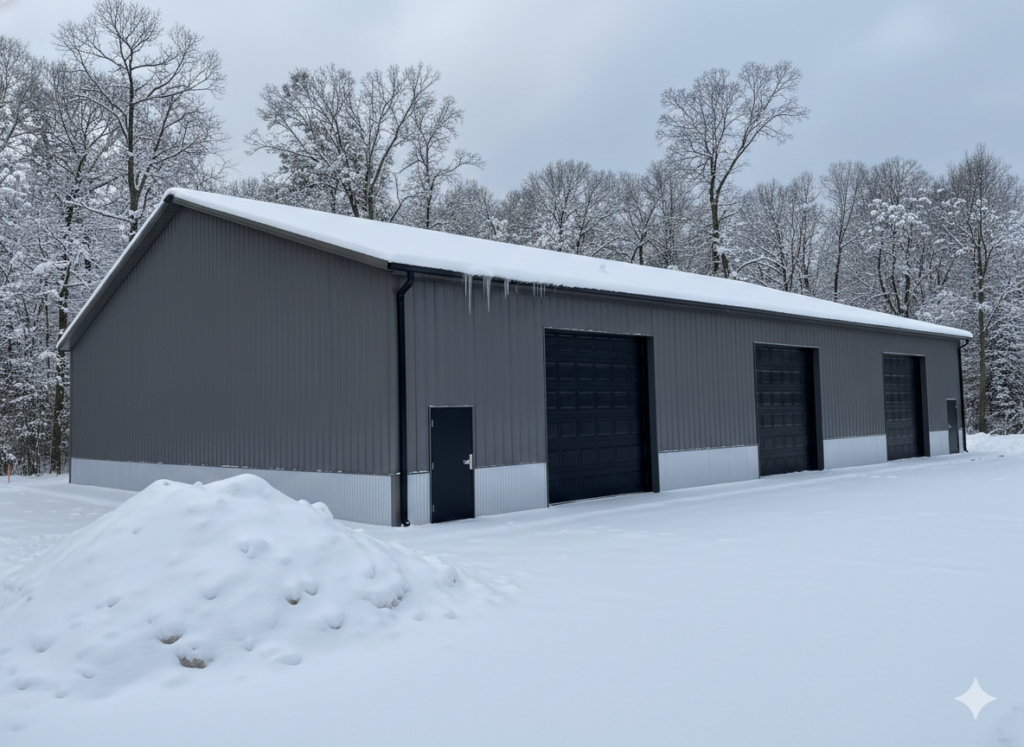
For property owners in Indiana and Michigan, a building is more than just a workspace or storage area; it is a shield against some of the most unpredictable and harsh winter weather in the country. From the heavy “lake effect” snow off Lake Michigan to the deep-reaching frost lines of Northern Indiana, the regional climate places unique physical demands on a structure.
Designing a post frame building in this region isn’t just about aesthetics—it’s about precision engineering that accounts for the specific physics of the Great Lakes environment. Understanding how snow loads and frost lines impact your building’s design is the first step in ensuring your investment lasts for generations.
The Weight of Winter: Mastering Snow Loads
In Indiana and Michigan, snow isn’t just a nuisance; it’s a massive structural load. Depending on your specific county, building codes may require a roof to support anywhere from 20 to over 50 pounds per square foot (psf).
A common misconception is that all snow is created equal. However, “lake effect” snow is notoriously dense and wet, weighing significantly more than the “powder” seen in drier climates. Furthermore, wind patterns can cause “snow drifting,” where snow piles up unevenly on one side of a roof or against a higher wall section.
A professionally engineered post frame building manages these forces through:
- Truss Engineering: Instead of standard off-the-shelf components, trusses are specifically engineered to match the snow-load requirements of your specific zip code. This ensures the roof won’t sag or fail under the weight of a record-breaking blizzard.
- Purlin Spacing: The horizontal boards that support the metal roofing (purlins) are spaced closer together in high-snow areas to prevent the metal panels from buckling between the rafters.
- Fastener Patterns: The way the metal skin is attached to the frame is calculated to resist the “sliding” force of snow as it melts and shifts, preventing the screws from shearing off.
The Ground Up: Respecting the Frost Line
While snow attacks from above, the frost line attacks from below. In Indiana and Michigan, the frost line—the depth to which the groundwater in the soil freezes—typically ranges from 36 to 48 inches.
When soil freezes, it expands. This phenomenon, known as “frost heave,” can exert thousands of pounds of upward pressure on a building’s foundation. If a foundation is too shallow, the freezing ground can literally lift the building out of the dirt, leading to cracked slabs, jammed doors, and warped frames.
Post frame construction is uniquely suited to combat frost heave, provided it is done correctly:
- Deep Embedment: Professional builders ensure that every structural post is set well below the local frost line. By placing the “foot” of the post in soil that stays at a constant temperature year-round, the building remains anchored and stationary regardless of the surface temperature.
- Uplift Anchors: To prevent the post from being “sucked up” by the surrounding frozen soil, we utilize concrete “cookies” or poured footings with uplift anchors. This creates a physical lock between the post and the stable earth below the frost zone.
Why Regional Expertise is Non-Negotiable
A “kit” building designed for a mild climate like Georgia or Texas will almost certainly fail in a Michigan winter. When you work with a regional leader like Pacemaker, you aren’t just buying lumber and steel; you are buying an engineering package tailored to the Midwest.
We understand that a commercial postframe building in South Bend faces different wind and snow pressures than one in Indianapolis. We account for the “Lake Effect” and the specific soil compositions found throughout the Great Lakes region. By integrating site-specific snow-load calculations and deep-frost-line foundation techniques, we provide more than just a building—we provide peace of mind that your equipment, livestock, and business are protected, no matter how hard the winter hits.
Ready to discuss your need? Contact us today!